
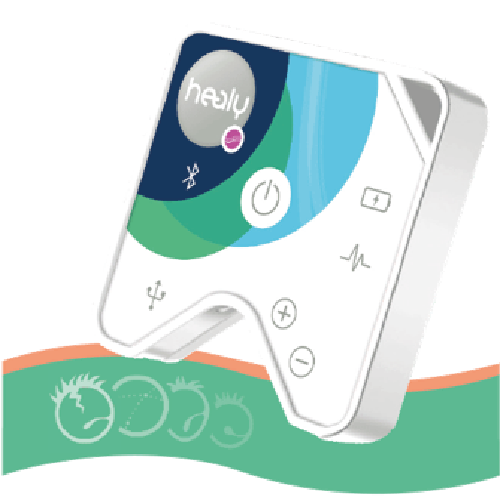
1. Background of the Healy & TimeWaver System
The Healy device is a pocket-sized alternative health gadget designed by German inventor Marcus Schmieke. Schmieke, who studied physics and philosophy before living as a monk in India, sought to bridge the gap between Western physics and Eastern spiritual concepts of consciousness. He initially created TimeWaver, a large, expensive clinical bioresonance machine aimed at professional alternative health practitioners.
Healy was introduced as a compact, consumer-grade extension of the TimeWaver technology. Marketed globally via multi-level marketing (MLM) and wellness influencers, the company asserts that the device utilizes a proprietary “quantum sensor” to communicate directly with an individual’s “bioenergetic information field”. The company claims that the device evaluates physiological and spiritual imbalances remotely and can deliver tailored vibrational frequencies across space to harmonize a person’s well-being.
2. In-Depth PCBA Reverse Engineering Findings
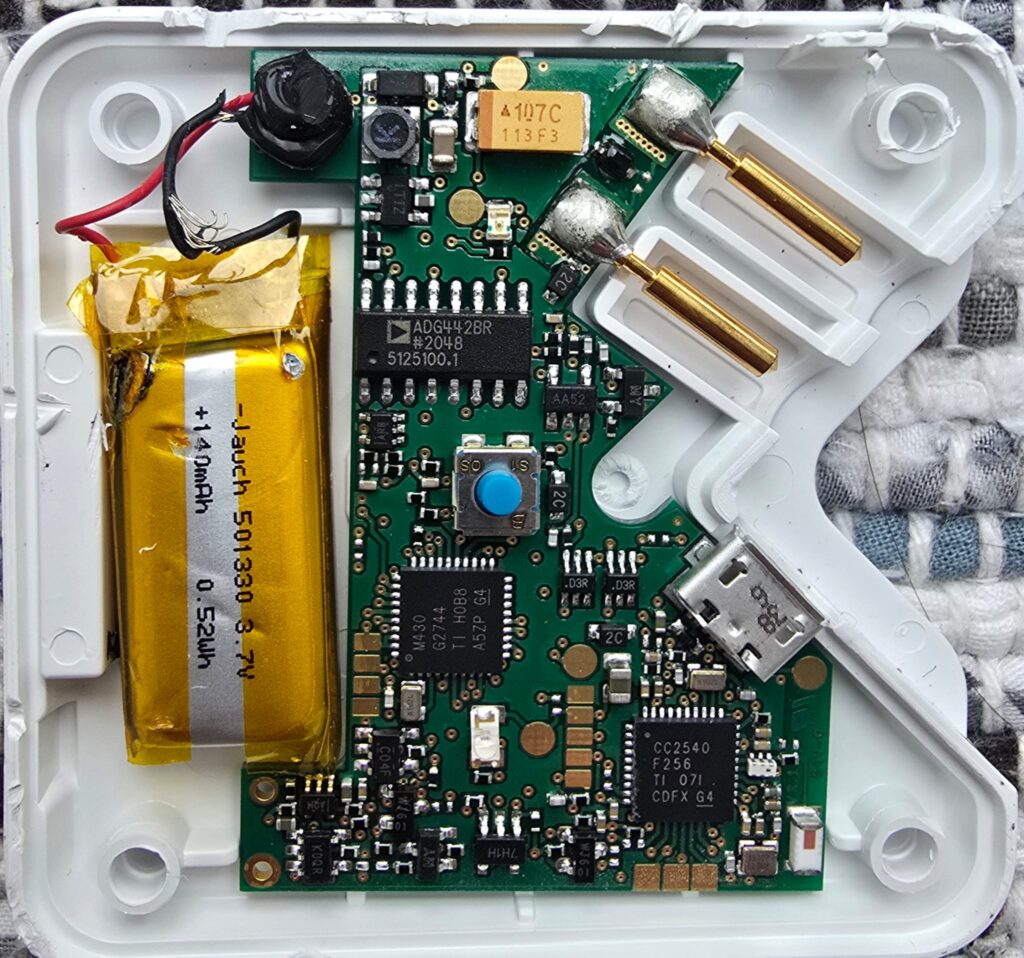
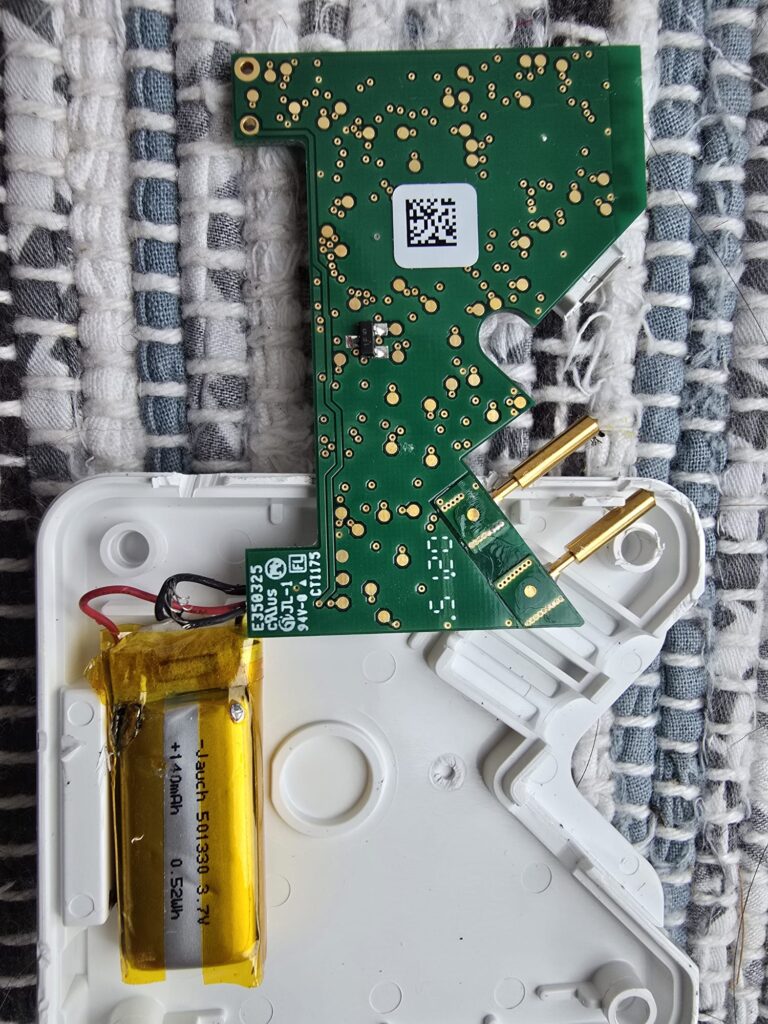
A rigorous, component-level analysis of the disassembled printed circuit board assembly (PCBA) reveals a well-built, but completely standard, consumer electronic design. It lacks any physical components resembling quantum processors, optical traps, or cryogenic sensors.
The major architectural groups on the board are:
- Wireless Transceiver Module (Texas Instruments CC2540): Positioned on the bottom right of the board. This is a conventional Bluetooth Low Energy (BLE) System-on-Chip (SoC). It handles standard 2.4GHz radio frequency communications, bridging the hardware physically to the companion smartphone app. It contains no mechanism for deep-field transmission or macro-scale quantum tuning.
- Central Processor (Texas Instruments MSP430): Labeled as
M430 G2744near the center bottom. This is an ultra-low-power, 16-bit mixed-signal microcontroller. Its fundamental engineering role is to act as the “brain” of the device—executing local firmware commands, routing power rails, and controlling output wave timers. - Analog Matrix Switch (Analog Devices ADG442BR): Located on the middle left. This integrated circuit consists of four independently selectable Single Pole Single Throw (SPST) analog switches. It is electrically wired to accept incoming digital signals from the MSP430 and route them toward the physical outputs, allowing the device to alternate the polarity and amplitude of its low-frequency electrical cycles.
- Mechanical Output Interfaces (Gold Pogo Pins): Two spring-loaded, gold-plated mechanical contact pins are soldered to the top right of the PCBA. These serve as physical terminals designed to hook into conductive wrist straps, adhesive electrode pads, or wires to send microcurrents directly into human skin.
- Decoupling Capacitor: The prominent rectangular yellow component (
107C) is a standard 100μF tantalum capacitor used to decouple power lines, smoothing out standard voltage ripples from the battery.
3. Remote Resonance Analysis: The Random Number Logic
The company states that its integrated “quantum sensor” evaluates the human body’s aura or chakra states remotely. From an electronic engineering perspective, this “quantum sensor” is structurally a True Hardware Random Number Generator (TRNG).
3.1 The Noise Generation Logic
- Exploiting Thermal Chaos: Inside solid-state silicon components (like resistors or semiconductor diodes operated in a specific current window), electrons fluctuate chaotically due to ambient thermal energy. This behavior creates a microscopic electrical variation called Johnson-Nyquist (thermal) noise or avalanche noise.
- Sampling the Noise Layer: The device features a standard analog circuit designed to run a baseline voltage through an internal component, amplifying this raw thermal micro-voltage fluctuation.
- Digitization: The MSP430 microcontroller’s onboard Analog-to-Digital Converter (ADC) samples these chaotic fluctuations. If the voltage peak lands above a specific threshold, it registers a binary
1; if it falls below, it registers a0. This acts as a continuous stream of raw, unpredictable binary data.
3.2 The Mathematical Mapping Illusion
The marketing team leverages the subatomic, quantum-probabilistic origins of electron movement to call this a “quantum sensor”. However, its behavior within the ecosystem is entirely mathematical:

When you start a remote “Information Field Scan,” the app requests a block of random data from the hardware via Bluetooth. The app then inputs this raw binary data as a mathematical seed into a localized database table. If the binary number maps to a specific slot, the app outputs a preset string text (e.g., “Crown Chakra Imbalance”) and converts the remaining entropy into a precise priority percentage (e.g., 66%).
3.3 How a Hardware White Noise Generator Actually Works
When a company claims a device contains a “quantum sensor” based on white noise, they are referring to a Hardware Random Number Generator (TRNG).
3.3.1 The Physical Mechanism
Inside any electronic component (like a resistor or a Zener diode), electrons bounce around randomly due to thermal energy. This is called Johnson–Nyquist noise or thermal noise.
- To capture it, the circuit runs a tiny baseline current through a component (often a diode in reverse bias, causing a miniature “avalanche breakdown” effect).
- This creates a tiny, highly chaotic, unpredictable fluctuating voltage.
- The device’s microcontroller (in your case, the MSP430) samples this fluctuating voltage line and converts the peaks and valleys into a stream of binary data (1s and 0s).
3.3.2 Why it Cannot Scan Your Environment or Body
- Electrical Isolation: The thermal noise generated inside a sealed semiconductor chip is isolated. It is a fundamental property of the atoms inside that specific piece of silicon.
- No Ambient Scanning: It does not act as an antenna or a radar. It cannot pick up the thermal movements of atoms in the room, nor can it detect electromagnetic fields radiating from a human body sitting a few feet away. To measure the electrical activity of a human body, you require direct physical contact (like an ECG/EEG electrode) or highly specialized, bulky magnetic shielding equipment (like an MEG scanner).
3.4 The “Large Database” and App Logic (The Software Illusion)
Your hypothesis about a large database is exactly how the software creates the appearance of a functioning remote scan. However, it is an algorithmic process in the app, not a physical reading from the hardware.
Here is the step-by-step breakdown of what happens behind the scenes during a “distance analysis”:
- Creating the Profile: You input a name, a birthday, and upload a photograph. In the software database, this profile is assigned a unique digital ID or string of numbers.
- The “Scan” Phase: When you press “Start Scan,” the smartphone app sends a command via Bluetooth to the device. The device activates its internal noise generator, samples a stream of random binary data (e.g.,
1011001011...), and beams those random numbers back to your phone. - Database Matching: The app uses a software algorithm to cross-reference the random binary string against a pre-loaded database of thousands of health parameters, emotions, homeopathic remedies, or chakra levels.
- The Mathematical Illusion: The algorithm uses the random data as a “seed” to calculate percentages. Because the raw data from the hardware is truly random, the results look highly variable and deeply specific (e.g., “78% imbalance in the Solar Plexus Chakra” or “Need for Gold Cycle Pure frequency”).
Because the app displays highly detailed spiritual, psychological, or physiological terms, our brains naturally look for patterns and confirmation (the Barnum/Forer effect), making the results feel personally accurate.
3.5 Why “Distance Healing” is Physically Impossible for this Hardware
The company claims that once an imbalance is found, the device can project the balancing frequency into the “Information Field” to heal the person remotely. From a physics perspective, this is completely false for two major reasons:
- Hardware Limitations: As seen on your disassembled PCBA, the only wireless transmitter on the board is the TI CC2540 Bluetooth chip. Bluetooth operates strictly on a standard 2.4GHz radio frequency with a maximum range of about 10 meters. It is physically incapable of beaming “healing information” across a city or country to another person.
- Misuse of Quantum Theory: Marketing materials often cite “quantum entanglement” to explain distance healing—implying that the person’s photo or name is “entangled” with the device. In quantum mechanics, entanglement requires pairs of subatomic particles to be generated together under extreme laboratory conditions (like lasers splitting photons). Furthermore, the No-Communication Theorem in quantum physics proves that quantum entanglement cannot be used to transmit data, signals, or biological energy across space.
As a result: The device does not perform any physical scanning of the external environment or your body at all; it reads the electronic noise generated by its own internal chip and adds various health indicators to these random numbers through software algorithms.
4. Empirical Field Experiments and Verification
The structural nature of this software lottery wheel was thoroughly tested using rigorous scientific controls over three sequential experiments:
Control Test 1: The Dual-Device Synchronized Test
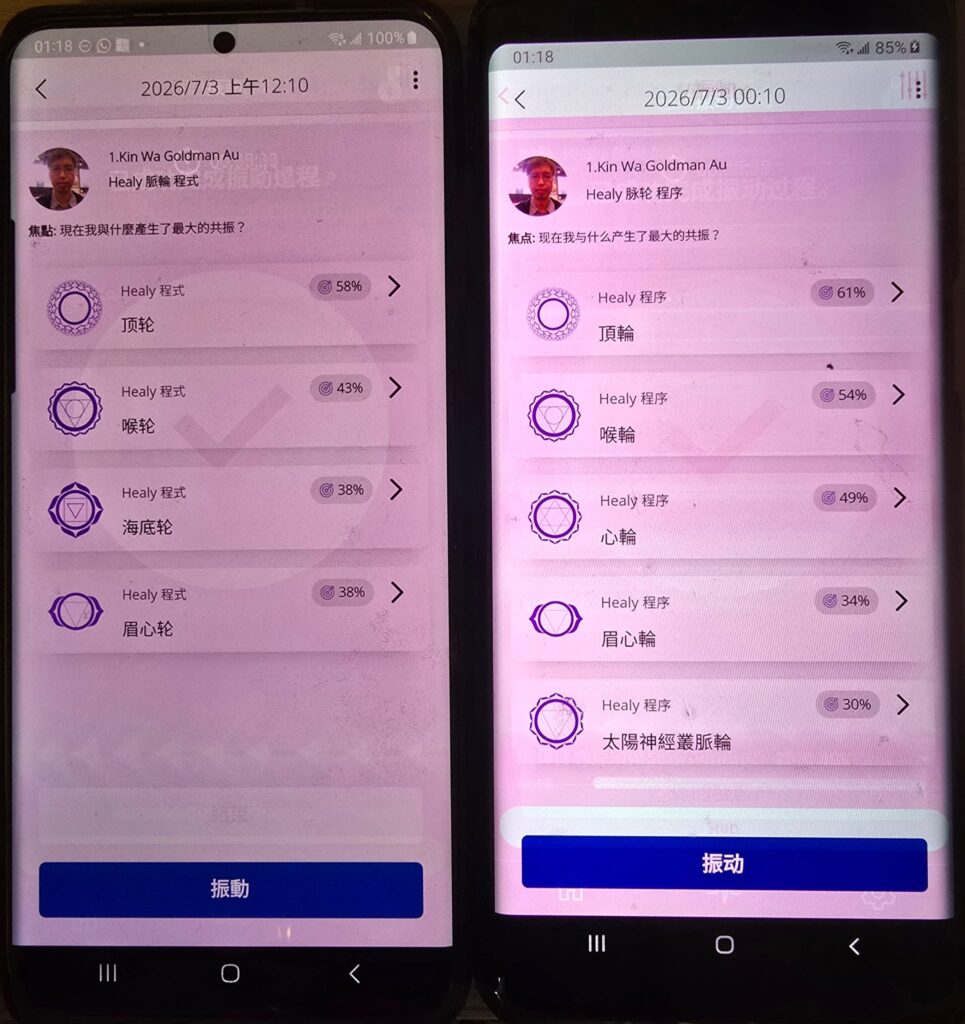
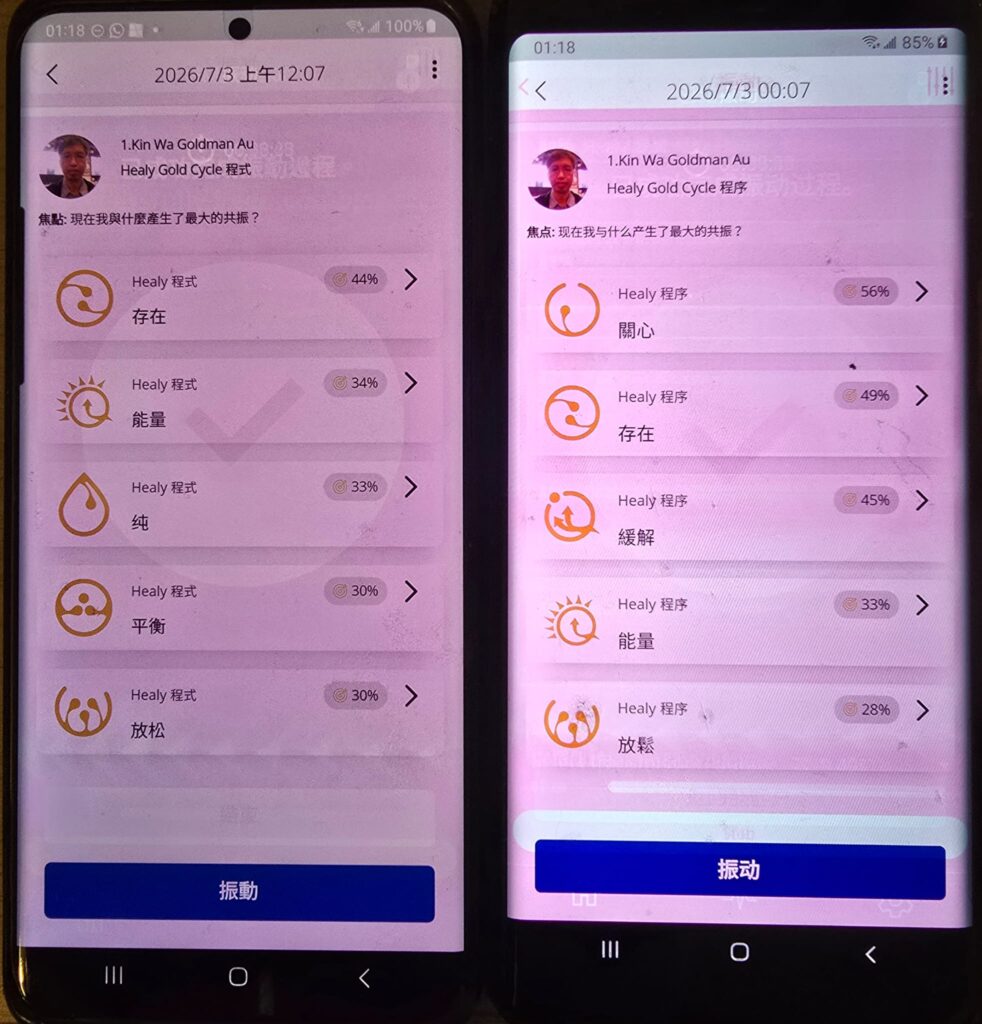
- Setup: One user profile was opened simultaneously on two separate smartphones, each connected to an independent Healy device. Both devices executed the “Gold Cycle” and “Chakra” remote scans at the identical moment.
- Results (Reflected in above two diagrams: The data diverged completely. Phone A reported a primary emotional priority of “Being” (存在) at 44%, while Phone B reported “Care” (关心) at 56%. The Chakra profiles similarly generated mismatched values and priorities across the board.
- Analysis: Because the human target was in an identical state, an actual field reader would yield tightly correlated, repeatable metrics. This complete data divergence confirms that each phone was drawing from isolated, uncorrelated streams of local hardware noise.
Control Test 2: The Deceased Profile Test
- Setup: A profile was established for a deceased individual, and a remote Chakra analysis was executed.
- Results: The software processed the request without error, producing a normal, active readout detailing localized energetic priorities.
- Analysis: A deceased biological system emits no metabolic, cardiac, or neurological electrical field. The app’s unhindered output proves it operates independently of live biological variables.
Control Test 3: The Inanimate Object Test
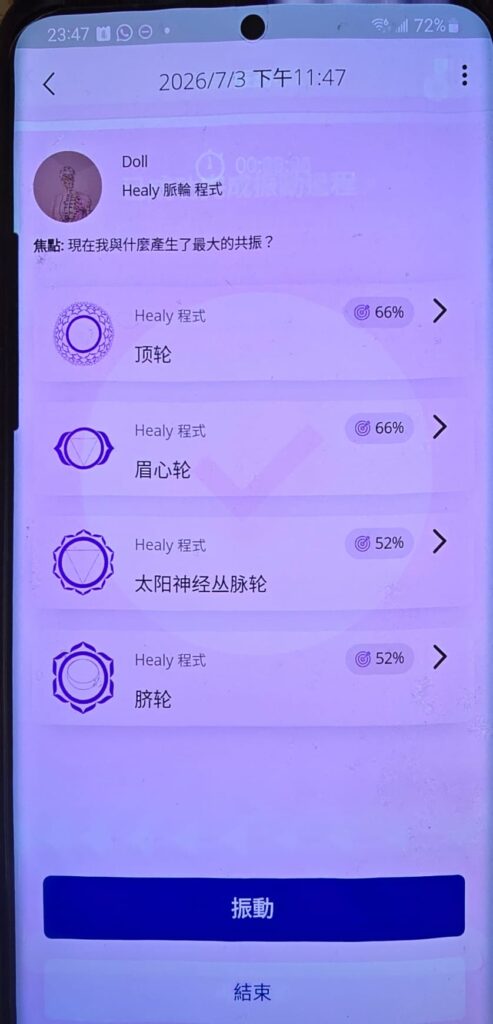
- Setup: To fully isolate the loop, a profile was generated using a toy doll, and a remote analysis was initialized.
- Results (Reflected in
above diagram): The software evaluated the doll, reporting a Crown Chakra (顶轮) resonance of exactly 66% and a Sacral Chakra (脐轮) resonance of 52%. - Analysis: This proves the app treats text strings and raw numbers identically. The algorithm runs blindly inside a closed loop, completely detached from the physical properties of the target object.
5. Legitimate Technical Functions vs. Pseudoscience
| System Modality | Onboard Physical Hardware | Engineering Reality & Scientific Validity |
| Wired Microcurrent (IMF Modality) | MSP430 Microcontroller —> ADG442 Switches —> Gold Pogo Terminals. | LEGITIMATE. Generates real, measurable low-voltage microcurrent waves to skin electrodes. This mirrors conventional Microcurrent Electrical Neuromuscular Stimulation (MENS), which stimulates localized cellular ATP and manages basic tissue pain. |
| Information Field Remote Scanning | High-gain circuit sampling internal semiconductor diode breakdown or thermal noise. | OVERCLAIMED. It is a Hardware Random Number Generator (TRNG). It harvests internal thermodynamic electronic static to pick items from a pre-made software dictionary. It has zero capability to scan human consciousness or health states. |
| Quantum Distance Healing | TI CC2540 2.4GHz low-power Bluetooth radio chip. | PSEUDOSCIENCE. The system possesses no long-range scalar or radio broadcasting arrays. Invoking “quantum entanglement” violates the No-Communication Theorem of quantum mechanics, which dictates that entanglement cannot transmit messages, data, or biological energy over a distance. |
6. Discussion: Why the Alternative Health System Still “Works”?
While the device’s remote resonance analysis is technically a randomizer, its clinical efficacy as an alternative health system is heavily supported by the psychology of nonspecific therapeutic effects:
- Structured Self-Reflection: When the app outputs random, broad wellness suggestions (e.g., “Focus on ‘Relax’ or ‘Balance'”), it bypasses logical scrutiny via the Barnum/Forer Effect. The user assumes the device knows their inner state, prompting deep, focused reflection on their current stress levels and forcing them to sit mindfully.
- Guided Attention & Tracker Effect: Engaging with a premium health tool daily acts as a permanent behavioral anchor. Users become highly conscious of their health routines, subconsciously eating better, resting longer, and drinking more water—subsequently attributing their improved vitality to the device.
- The Neurobiology of Placebo: Believing that an advanced quantum machine is projecting healing fields lowers systemic cortisol and adrenaline levels. This down-regulation of stress chemicals relaxes physical muscle tension, decreases anxiety, and triggers real dopamine and endorphin pathways, providing genuine physiological comfort.
Conclusion
The Healy device is a technological hybrid that combines a real “wired microcurrent generator” with a fictitious “digital remote divination app.” While its advertised quantum remote healing principles completely contradict modern physics, as a health management process that encourages mindfulness, guides healthy attention, and induces a placebo effect, it can indeed bring real improvements to the quality of life for some users on a psychological and behavioral level.
Comments welcome: If you have been or are still a user of healy’s remote functionality, have you ever doubted its performance? I hope you can leave a message and tell me how long you have been using it?