
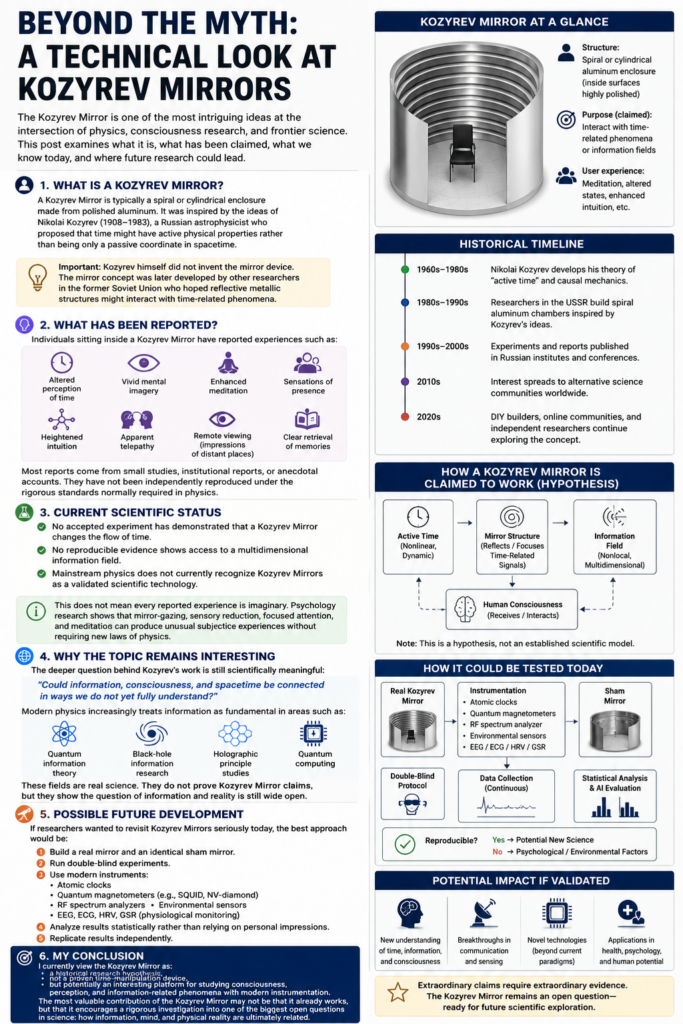
For more than half a century, the Kozyrev Mirror has remained one of the most fascinating—and controversial—ideas at the intersection of physics, consciousness research, and the possibility that information itself may be a fundamental property of reality.
Some people describe it as a device capable of enhancing intuition, altering the perception of time, or even interacting with a mysterious “information field.” Others dismiss it entirely as pseudoscience.
After spending considerable time studying its history, reviewing available literature, and comparing it with modern technologies such as quantum sensing, biofeedback systems, and information theory, I believe the truth is more nuanced.
The Origin of the Kozyrev Mirror
Many people believe that Nikolai Kozyrev (1908–1983) invented the Kozyrev Mirror.
Interestingly, he did not.
Kozyrev was a Russian astrophysicist who proposed a highly unconventional theory known as Causal Mechanics, suggesting that time might possess active physical properties rather than being merely a dimension through which events occur.
Inspired by his ideas, later Soviet researchers constructed spiral and cylindrical chambers made from polished aluminum, hoping that these reflective structures might somehow interact with the physical properties of time.
These devices eventually became known as Kozyrev Mirrors.
What Have People Reported?
During experiments conducted mainly in Russia during the 1990s, participants reported experiences such as:
- altered perception of time
- unusually vivid memories
- enhanced meditation
- sensations of heightened awareness
- apparent intuitive insights
- occasional reports of telepathy or remote perception
These reports attracted considerable attention within consciousness research communities.
However, there is an important distinction:
Subjective experiences are not the same as objective scientific evidence.
Most reported effects relied on personal experiences rather than independently reproducible physical measurements.
What Does Modern Science Say?
As of 2026:
There is no accepted experimental evidence demonstrating that a Kozyrev Mirror can:
- manipulate time
- amplify unknown physical fields
- access higher dimensions
- communicate through a universal information field
Mainstream physics does not currently recognize Kozyrev Mirrors as validated scientific instruments.
That said, this does not automatically mean every reported experience is imaginary.
Modern psychology has shown that meditation, sensory isolation, focused attention, and mirror-gazing can all produce profound changes in perception without requiring new laws of physics.
The challenge is determining whether Kozyrev Mirrors produce anything beyond these well-understood effects.
Why Does the Topic Remain Interesting?
Although the mirror itself remains unproven, the deeper question behind Kozyrev’s work is still scientifically meaningful:
Could information, consciousness, and spacetime be connected in ways we do not yet understand?
Interestingly, modern theoretical physics increasingly treats information as a fundamental concept.
Examples include:
- quantum information theory
- the black hole information paradox
- the holographic principle
- quantum error correction models of spacetime
These developments do not prove Kozyrev’s ideas.
However, they suggest that information plays a much deeper role in physics than previously believed.
Whether consciousness also participates in that framework remains one of science’s biggest unanswered questions.
Where Could Future Research Go?
One reason Kozyrev Mirror research has stalled is that most historical experiments relied heavily on subjective observations.
Today, we possess tools that were unimaginable when these experiments were first conducted.
Imagine combining a Kozyrev Mirror experiment with:
- atomic clocks
- quantum magnetometers (NV diamond sensors)
- RF spectrum analyzers
- EEG brain monitoring
- heart-rate variability analysis
- galvanic skin response
- AI-assisted statistical analysis
- double-blind experimental protocols
Rather than asking participants, “Did you feel something?”, we could ask:
“Did anything objectively measurable happen?”
That represents a far more rigorous scientific approach.
My Personal Perspective
I do not consider the Kozyrev Mirror to be either a proven scientific device or something that should simply be dismissed without investigation.
Instead, I see it as an unfinished scientific hypothesis.
History reminds us that many revolutionary discoveries were initially controversial.
At the same time, history also teaches us that extraordinary ideas require extraordinary evidence.
If Kozyrev Mirrors truly interact with time, information, or consciousness, modern instrumentation should eventually be capable of detecting measurable, repeatable effects.
If no such effects are found under rigorous testing, that result would also advance our understanding.
Either outcome contributes to science.
Why This Matters
Whether the Kozyrev Mirror ultimately proves to be a misunderstood psychological phenomenon or the beginning of an entirely new branch of physics, it reminds us of something important:
Progress begins with curiosity, but it advances through careful experimentation.
As an engineer, I believe our responsibility is neither to believe extraordinary claims blindly nor to reject them automatically.
Instead, we should build better experiments.
Only then can we separate mythology from measurable reality.
“The greatest discoveries often begin as impossible questions—but they only become science when they can be measured.”
Final Thought
I’m currently exploring several frontier technologies and ideas, including Healy devices, TimeWaver, Kozyrev Mirrors, quantum sensing, and information-field theories. My goal is not to prove or disprove any particular claim, but to examine them through the lens of engineering, physics, and reproducible experimentation.
If these topics interest you, I’d love to exchange ideas with researchers, engineers, physicists, and anyone curious about where the boundaries of current science may eventually expand.