
Abstract
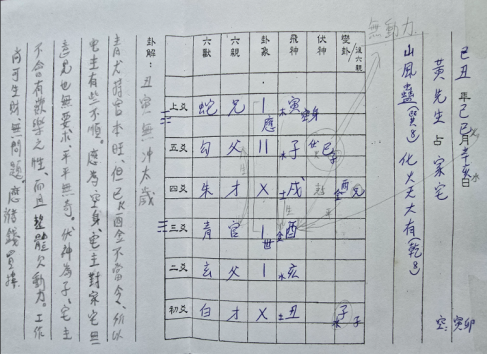
This report explores the analytical potential of Generative AI (Large Language Models) within the domain of Six-Yao Prediction (Wen Wang Hexagram system), a highly structured form of traditional Chinese metaphysics. By utilizing Gemini AI to conduct deep logical deductions on two real-world historical cases—a domestic residential inquiry and a career transition analysis—this study evaluates AI’s accuracy in hexagram formation, heavenly stems and earthly branches alignment, and advanced symbolic interaction logic.
The empirical findings demonstrate that when guided by a well-structured prompt architecture, Gemini AI possesses exceptional context-awareness and error-correction capabilities. It effectively eliminates the subjective biases and ambiguities often found in conventional fortune-telling practices. By processing the deterministic rules of Five-Element dynamics, Xun-Kong (void status), and the Six-Beast context, AI delivers highly rational, objective, and granular analytical reports. This study confirms that AI can serve as a reliable, highly accessible, and cost-effective analytical tool for traditional metaphysics, paving a new path for the digital transformation of ancient experience-based systems.
The Inherent Limitation in Hexagram Generation: A critical limitation of AI in traditional divination lies in the initial stage of Hexagram Generation (起卦). Traditional Yi-Bu relies heavily on “Tian-Ren-Gan-Ying” (Universal-Human Resonance / Telepathy) and “Chu-Ji” (Spontaneous Synchronicity). The physical act of rolling coins requires the seeker’s intense subjective consciousness to resonate with the cosmic field. Empirical evidence shows that different masters may derive different hexagrams and insights for the same event; masters with higher spiritual cultivation and focus yield far more accurate and actionable conclusions. Conversely, AI can only generate “random” hexagrams via pre-programmed algorithms (pseudo-random number generators), which inherently lacks human consciousness and spiritual synchronicity, making purely AI-generated hexagrams questionable in accuracy.
The Ultimate Value of AI: However, once a valid hexagram is generated by a human through traditional physical methods, the subsequent phase—Hexagram Analysis and Deduction (斷卦)—follows strict mathematical rules, structural logic, and strict interaction formulas. This is where AI excels. By acting as an objective, emotionless “Logical Decoder,” AI can process complex symbolic relationships and deliver highly sophisticated, granular, and unbiased metaphysical analyses, maximizing its value as an advanced analytical companion.
I’d welcome any feedback or discussion.
Note on Language:
The full research report is written in Chinese as the primary target audience for this localized metaphysical framework is Chinese-speaking researchers and practitioners. However, the document is fully compatible with modern AI translation infrastructure. If you are an international reader, you can easily translate the complete text into your preferred language using Google Translate, DeepL, or any advanced LLM tool.
Full report link:
AI 技術在中國傳統易卜命理預測中的應用與案例驗證報告 – Information Technology Manage Factory 管理廠房資訊科技系統