
Preface: The Struggle Between Reason and Emotion for a Tech Professional
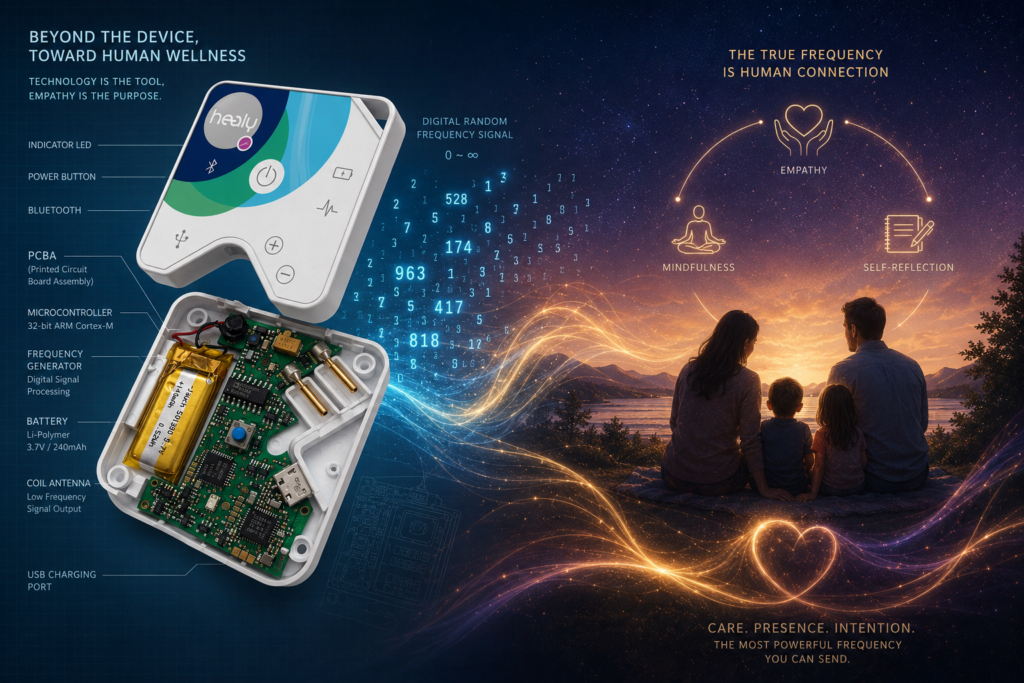
When I first came across this wellness device, which claims to use a “quantum sensor” to connect with a person’s “information field” for “distance healing,” my background in technology drove me to verify these claims with a rigorous scientific approach.
However, after performing a hardware teardown and running strict control experiments, I completely saw through the mathematical randomness of its remote functions. Yet, I noticed that my family and I had already developed a psychological reliance on it—“running it every day brings peace of mind; if it isn’t run and an issue occurs, I immediately blame myself for not pressing the button.”
This contradictory state of simultaneously doubting yet operating the device inspired me to write this piece. By sharing my journey from “physical debunking” to “psychological offloading,” I hope to help more people reclaim their sense of personal autonomy.
Chapter 1: Hardware Reverse Engineering & Control Experiments (The Awakening of Reason)
To understand exactly how the system functions, we first conducted physical teardowns and empirical testing. The results unmasked three shocking technical realities:
- Zero Quantum Components in the Hardware: Tearing down the circuit board revealed standard, off-the-shelf consumer electronics. It features a Texas Instruments low-power Bluetooth chip (solely for communicating with a smartphone) and an MSP430 microcontroller (for power switching and pulse generation). The so-called “quantum sensor” is structurally nothing more than a Hardware True Random Number Generator (TRNG) that harvests microscopic thermal static from internal circuits to generate random binary data (1 and 0).
- Direct Mismatch in Dual-Device Scans: We logged into the same account on two separate phones, connected each to an independent device, and initiated “Chakra” and “Gold Cycle” scans on the exact same person at the exact same second. The two devices returned completely different priority rankings and percentages. This proves the hardware is not reading an objective, external “biological field”—it is simply two independent devices rolling their own internal digital dice.
- Inanimate Objects Can Be Diagnosed: We created profiles in the app for a deceased relative and even a plastic toy doll. Unbelievingly, the software ran flawlessly, confidently diagnosing the plastic doll with a “66% resonance imbalance in its Crown and Third Eye Chakras.” This definitively isolates the loop: the software cannot differentiate between human consciousness and a piece of plastic. It is a blind, closed-loop random mapping algorithm.
💡 Technical Verdict: Its “Wired Microcurrent Mode” (when physically connecting cables to the skin) is a real, legitimate physical therapy tool. However, its “Remote Analysis and Distance Healing” functions are entirely fictional from both a physics and quantum mechanics standpoint.
Chapter 2: Why Does It Still Feel “Incredibly Accurate and Effective”? (The Psychological Decryption)
If the remote technology is fictional, why did we frequently marvel at its “uncanny precision” during past use? This illusion is driven entirely by two core cognitive mechanisms of the human brain:
1. The Barnum Effect — The Illusion of Personal Accuracy
The Barnum Effect states that individuals are highly prone to believe vague, universally applicable statements about their state or personality, firmly believing they were tailored specifically for them (this is the underlying science behind horoscopes and fortune-telling).
When the app randomly selects phrases like “Your heart chakra needs to release past emotional suppression” or “You need to find balance in your relationships,” our brains activate a Confirmation Bias. We instantly dig through our memories to find a matching event (e.g., “Wow, I did have an argument with my colleague last week!”). It is not the machine predicting your life; it is your brilliant brain doing the hard work of connecting the dots.
2. The Hawthorne Effect & Directed Attention — The Power of Being Kept in Mind
Every time you open the app and select the “Learning,” “Work,” or “Sleep” program for your family, this action acts as a powerful psychological anchor. Your family members perceive your care and focused attention. In behavioral science, this triggers the Hawthorne Effect, prompting them to subconsciously regulate their behavior (e.g., automatically putting away distractions during study or focusing deeper at work). When their productivity naturally improves at the end of the day, we mistakenly attribute the success to the white box blinking with random signals.
Chapter 3: How to Elegantly Free Yourself from “Psychological Reliance”? (Practical Actionable Steps)
Once you recognize the physical illusion and the psychological mechanisms at play, you can gently offload the anxiety of “not pressing the button” through three practical steps:
1. Cognitive Reframing: From “Quantum Device” to “Mindfulness Ritual”
You do not need to throw the device away in a fit of frustration. Allow yourself to use it, but strip away its divine “quantum” status. Redefine it as a “Mindfulness Timer” or a “High-Tech Talisman” that helps you anchor your thoughts. When it runs, it simply represents the time you set aside to actively care for your family. When it doesn’t run, there is zero cause for panic, because it never possessed the physical capability to alter reality from a distance in the first place.
2. Behavioral Desensitization: The Control Variable Experiment
Break the false causal link in your brain using standard scientific testing. Without telling your family, deliberately stop running the sleep or study programs for a few days and quietly observe their performance. You will quickly find that even without the app, they still sleep soundly and study effectively on the vast majority of days. By gradually fading out the device, your brain will unlearn the false fear.
3. Transitioning from “Machine Empowerment” to “Internal Empowerment”
Instead of relying on a virtual progress bar on a screen, transition your family’s focus to time-tested, tangible lifestyle habits:
- For Work & Study (The Pomodoro Technique): Replace the app’s “learning program” with a real time-management method: 25 minutes of absolute focus followed by a compulsory 5-minute break. This short, rhythmic pattern matches the brain’s natural physiological limits and builds genuine internal execution skills.
- For Sleep & Emotional Wellness (Physical Rituals): Establish sound sleep hygiene—turn off electronics an hour before bed, dim the lights, or play actual physical soundscapes like rainfall or singing bowls. The physical feedback of these environmental adjustments is far more grounding than an invisible remote frequency.
Conclusion: Reclaiming Your Personal Autonomy
Doubting is not shameful, for doubt represents the awakening of your intellect. Relying on the device is nothing to blame yourself for either, as that reliance stems from your deep, protective love for your family.
Ultimately, we must realize that our family’s health, academic progress, and peaceful sleep rely entirely on their own biological resilience, their internal willpower, and the tangible care you give them. The true control panel of our lives has always been in our own hands—not inside a small white plastic box. Hopefully, this rational analysis brings a sense of clarity and peace to anyone feeling conflicted on their wellness journey.